
Introduction
Financial Advisor IQ just ran a five-part special report on where fixed income is heading. The fourth piece, “How AI Is Changing the Game in Fixed Income”, asked asset managers and technology firms a blunt question: is AI rebuilding the bond business, or just making the old one faster? bondIT was one of the firms featured.
Our answer is that the change is real, but it is not the one the headlines fear. AI is not pushing analysts and advisors out of the work. It takes over the slow, repetitive parts so people can spend their time where judgment matters. Here is how that plays out across the bond desk.
See the Signal Hidden in 50,000 Issuers
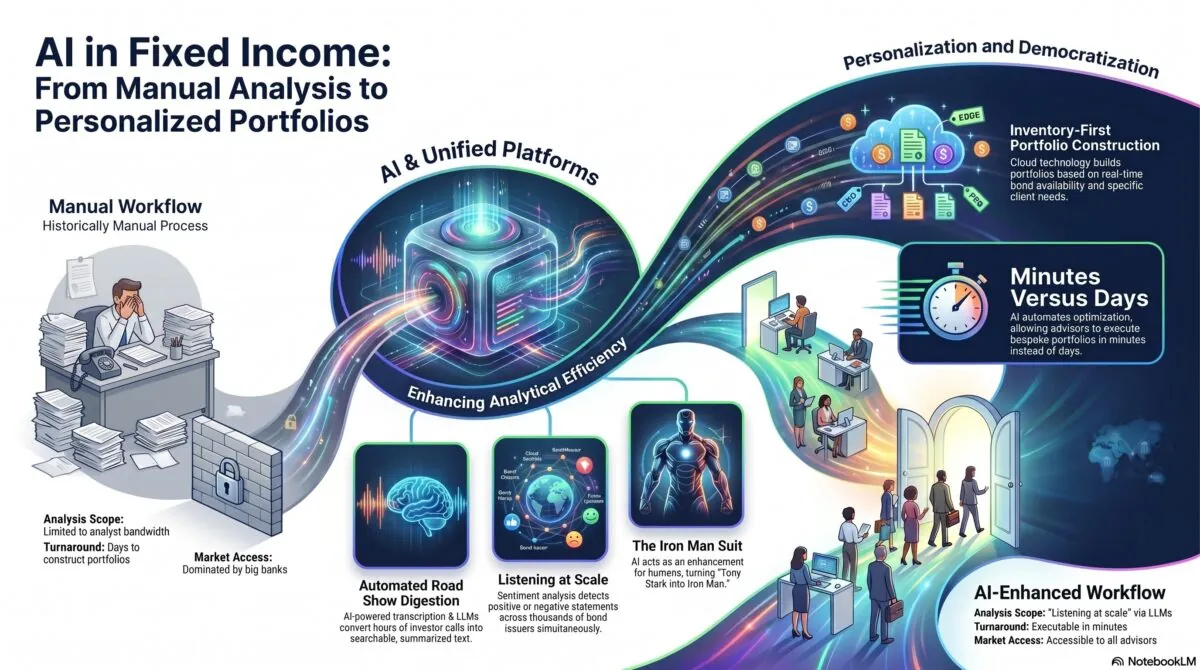
Northern Trust’s municipal bond team described the scale problem plainly. They start with more than 50,000 issuers, cut that to about 6,000 worth a closer look, and then analyze them with a credit team that, in the words of global head of customized fixed income Morten Olsen, is “fairly stretched.” Their fix came out of a company hackathon: a tool that lets analysts query hours of investor calls in seconds.
- Turn hours of road shows and investor calls into searchable text with AI transcription
- Query that text for what matters: sentiment shifts, strategy updates, what the CFO actually said
- Let one call inform the whole team instead of a single analyst’s notes
As Olsen put it, the tool gives them “an opportunity to listen at scale.” bondIT’s Scorable applies the same idea to credit risk, analyzing 250+ variables across roughly 3,000 rated issuers every day to flag rating changes before the agencies do.
Move From Build-Then-Source to Inventory-First
For a lot of fixed income work, the usual order of operations is backwards. You design a model portfolio first, then go hunting for bonds that fit it. Often the bonds you built around aren’t actually available, and the model has to be reworked around what the market will give you.
- Start from a live, cross-market view of the bonds you can actually buy right now
- Let AI build and optimize around each client’s risk level, return target, and sector preferences
- Hand the client a portfolio they can execute in minutes, not days
This is the core of how bondIT’s Frontier works. An inventory-first approach turns portfolio construction from a multi-day project into a same-meeting conversation, and it lets the same level of tailoring reach further down the book, not just the largest accounts.
Open Bond Access Beyond the Big Banks
For decades, building custom bond portfolios was effectively the preserve of the big banks. Equities opened up to everyone long ago. Bonds did not. Technology is closing that gap.
- Put institutional-grade bond tools in front of advisors, not only trading desks
- Extend personalized portfolios down the book, beyond the largest clients
- Give end investors direct access to a market that used to sit behind a bank
That is the part of the AI story that gets undersold. The headline is usually efficiency. The deeper change is reach.
Reform, Not Replacement
So does any of this put analysts or advisors out of work? We do not think so. The firms getting value from these tools are not handing the work to a machine. They use AI for the listening, the sorting, and the first-pass construction, so people can spend their time on the calls that close business and the judgment that data can’t make. Across 165+ institutions and more than $1 trillion in assets on the bondIT platform, the pattern holds: advisors who adopt these tools pitch with more specificity and more personalization, because now they have the analysis to back it up.